
CSSD Call for Applications for Two Business Office Positions: Communications Coordinator & Events Coordinator
Call for Applications
for ABD Graduate Students

The Center for the Study of Social Difference [CSSD] is looking for two ABD graduate students to join the CSSD Business Office for at least one academic year. We are searching for applicants interested in a cross-disciplinary approach to issues of social difference locally and globally. CSSD works across the University to support faculty Working Groups and social engagement projects that foster ethical and progressive social change. To learn more about CSSD, please visit our website.
Candidates can develop administration skills by working closely with the CSSD staff on Center operations and project management. They should expect to commit 10 hours per week to their roles at the Center.
ADMINISTRATIVE COORDINATOR RESPONSIBILITIES:
Events Coordinator: Primary responsibilities include organizing Working Group requests for meetings, events, and travel
Communications Coordinator: Primary responsibilities include preparing CSSD communication for the newsletter, social media, blog, and annual report
ADMINISTRATIVE COORDINATOR PAY:
The administrative coordinator roles offer an expected total pre-tax salary of $5K/semester (assuming 10 hours per week). It will be paid out hourly through the casual student administrative worker position, or ‘additional compensation’ if holding a Student Officer position simultaneously. The application deadline is May 3, 2024, with qualified candidates contacted or interviewed on a rolling basis. Apply early for the best opportunity for consideration. The start date is Monday, Sept. 2.
TO APPLY:
Applicants should email CSSDassistant@gmail.com the following information by May 3.
Please include CSSD Coordinator Position in the Subject line.
CV and cover letter
1-2 paragraphs describing your interest in working with CSSD, your administrative experience, and expected commitments for the September 2024 – June 2025 term
Name and contact information for three references
Seeds of Diaspora WG Director Lynnette Widder to Co-Sponsor April 10 Event, Titled "The Great Padma: The Epic River that Made the Bengal Delta"
Seeds of Diaspora WG Director Lynnette Widder will be co-sponsor an April 10 Event along with the Columbia Climate School, titled "The Great Padma: The Epic River that Made the Bengal Delta.”
Among others sponsoring and contributing to the event are CSSD fellows Anelise Chen and Ana Paulina Lee.
We hope you are able to participate in this phenomenal event.

Transforming Prison Education from the Inside: How a Columbia Initiative is Impacting Change
In spring of 2023 CSSD Graduate Administrative Fellow Tomoki Fukui interviewed Professor Jean Howard, Director of the Prison Education and Social Justice Working Group, and Patrick Anson, Graduate Assistant for the project. This piece is based on that interview and updated to include events undertaken this year.
Over the past three years the Prison Education and Social Justice Working Group at CSSD has worked to prepare students and faculty to teach inside prison and so to expand educational opportunities for incarcerated men and women.
Teaching inside prison presents unique challenges and opportunities. The group has worked to understand this site of work and to prepare classes that will engage and benefit students who attain their degrees by persistence and resilience.
Those who teach inside, the group discovered, will have their materials scrutinized by Department of Corrections officers before they are cleared to be taught; they themselves will undergo background checks and fingerprinting as a condition of work; and they will need to show unfailing politeness to the prison personnel who screen them when they arrive to teach and monitor the movements and actions of both students and faculty inside the facility.
Part of the Working Group’s task, therefore, was simply to understand how to successfully navigate the prison environment as an instructor at a very particular site of work. The group was aided in this task by speaking regularly with those at Columbia’s Center for Justice, like Claudia Rincón, who coordinate instruction inside affiliated prisons. The group also spoke with instructors who have taught inside and so learned from their experience, and it greatly benefited by engaging regularly with formerly incarcerated students who shared with the group what they found to be the most stimulating and helpful courses and teaching strategies that they had encountered while they were part of prison education programs.
Because, for example, courses often meet at night after the students have been busy with other activities and work assignments for much of the day, it’s important to incorporate active elements into a class plan: structured debates, movement exercises, small group activities that engage everyone. The group read a number of articles that theorize the prison classroom, the kinds of learning that flourishes in that environment, and the relationship of prison education initiatives to abolitionist politics.
Because faculty by and large can’t hold office hours and class time is limited to two hours a week, with some of that time often lost to late starts and interruptions by prison officials, it is incredibly helpful to have graduate students accompany faculty into prison classes. Course assistants and faculty can, for example, divide the work of holding one-on-one conferences at the side of the room and leading discussions with the rest of the class; or they can each facilitate a small group discussion or help prepare materials each week to supplement and enliven individual classes or to find essays that will help students with research papers.
Part of the group’s work has involved conversations with the Dean of Arts and Sciences and the Dean of the Graduate School to allow a certain number of faculty to count prison teaching as part of their regular course load and to provide modest stipends for graduate students to serve as course facilitators. We are grateful for the enthusiastic support of the Deans and hope these opportunities will be expanded as needed.
In academic year 2023-24, various members of the working group have taught prison courses. Professor Jennifer Middleton, supported by graduate student Nick Ide, taught “Earth: Origin, Evolution, Processes, Future” at Sing Sing Correctional Facility in the fall semester. Currently, Professor Alisa Solomon is teaching “Journalism and Public Life” at Sing Sing; Professor Samuel Kelton Roberts is teaching “Histories of Public Health in Communities of Color: The Built Environment in the 20 th Century United States” at Taconic Correctional Facility; and Professor Julie Crawford is teaching “Paradise Lost, Frankenstein, and Toni Morrison’s Paradise” at Taconic.
In addition, working group member Catherine Suffern, now working as Program Coordinator for the Justice-in-Education Initiative, has updated the comprehensive handbook for faculty and graduate students teaching in prison, and she and Patrick Anson organized a highly successful informational session for graduate students wishing to become course facilitators for prison classes on March 4.
The working group is in its final semester, but the intention is for its members to continue contributing to prison instruction going forward, as well as to helping students returning from prison to continue their education at Columbia or other institutions of higher education. Prison education is an established, if under-recognized, part of Columbia life. As a collectivity, the Prison Education and Social Justice working group is committed to seeing it thrive and evolve.
Edited by Professor Jean Howard, Patrick Anson, and Evan Berk.
Premilla Nadasen, Co-Director of the Transnational Black Feminisms WG, to Lead Two Events this April on Care
Premilla Nadasen, Co-Director of the Transnational Black Feminisms Working Group, the Barnard Center for Research on Women, and Ann Whitney Olin Professor of History at Barnard College, will be leading to events this April related to the theme of Care.
April 5-6, 2024: Care, Racial Capitalism, and Social Reproduction, led by Premilla Nadasen (BCRW C0-Director and Ann Whitney Olin Professor of History), brings together scholars, organizers, and artists to consider the intersections of social reproduction, racial capitalism, care, the state, and liberatory social change. Social reproduction signifies the labor necessary to maintain and reproduce human life and the labor force. It provides a lens to consider the social relations through which life is made, sustained, and might be transformed. Drawing on the long history of organizing and theorizing forged by feminist activists, low-wage women of color organizers, and scholars who have pushed us to expand our political analysis to include the dimensions of paid and unpaid domestic, emotional, and reproductive labor, this project considers the following questions: What is social reproduction and why does it matter? How does social reproduction broaden the scope of what counts as work and who counts as a worker? How does racial capitalism help us analyze and understand the value of social reproduction? How is the changing landscape of social reproduction reflective of political and economic shifts? And how is capitalism remaking itself in relation to social reproduction? Building on the work of feminist scholars and activists and the Black Radical Tradition, we also consider how social reproduction can and has been a site of organizing: What are the possibilities and limits of care for labor organizing, disability justice, and abolitionist organizing? How do we understand care in relation to social transformation and the state? Learn more about this event on the BCRW page here.
April 18, 2024: Care: the Highest Stage of Capitalism
Premilla Nadasen (Barnard College) will be joined by Dorothy Roberts (University of Pennsylvania) to discuss her new book, Care: The Highest Stage of Capitalism (Haymarket Books, 2023), a powerful critique of capitalist care relations and the economic profit extracted from care. Care traces the rise of the care economy, from its roots in slavery, where there was no clear division between production and social reproduction, to the present care crisis, experienced acutely by more and more Americans. Today’s care economy, Nadasen shows, is an institutionalized, hierarchical system in which some people’s pain translates into other people’s profit. Yet this is also a story of resistance. Low-wage workers, immigrants, and women of color in movements from Wages for Housework and Welfare Rights to the Movement for Black Lives have continued to fight for and practice collective care. These groups help us envision how, given the challenges before us, we can create a caring world as part of a radical future. Learn more about this event on the BCRW page here.
Read Now! New Blog Post on the Prison Education & Social Justice Working Group: "Tranforming Prison Education from the Inside"
Click this link to read the latest blog post on the Prison Education and Social Justice Working Group, titled “Transforming Prison Education from the Inside: How a Columbia Initiative is Impacting Change.”
Lilian Chee from the Insurgent Domesticities WG Contributes to New Book, Architectures of Care (Routledge, 2023)
Insurgent Domesticities Working Group Member Lilian Chee has contributed a chapter, titled “Titled “Domesticity and the Architecture Film: Caring-With Architecture,” to the recently released book: Architectures of Care: From the Intimate to the Common (Routledge, 2023).
To read more about the book launch for this work, as well as its related text, Architecture from Public to Commons (Routledge, 2023), follow this link.
Read Now! New Blog Post, titled "Extraction, Waste, and Security," following Extractive Media's Event on March 4
Click here to access Extractive Media’s latest blog post follow their March 4 seminar with scholars Eleanor Johnson and Jonah Rowen.

Plate 1, “The Colonial House,” from Carl Bernhard Wadström, An Essay on Colonization (1794).
For information on the past event itself, you can access the original event page here.
2024 Call for Proposals Deadline Approaching: Friday, March 8, at 9 AM
This is a kind reminder that the Center for the Study of Social Difference’s deadline for accepting project proposal submissions is this Friday, March 8, at 9 AM.
We look forward to receiving your submissions.
A Range of Columbia Courses Being Taught by Participants in the Prison Education Working Group
Participants in the Prison Education and Social Justice Curricula Working Group have been teaching a range of Columbia courses in prisons.
Professor Jennifer Middleton, supported by Nick Ide, taught “Earth: Origin, Evolution, Processes, Future” at Sing Sing Correctional Facility in the fall semester.
Professor Alisa Solomon is teaching “Journalism & Public Life” at Sing Sing this spring.
Professor Samuel Kelton Roberts is teaching “Histories of Public Health in Communities of Color: The Built Environment in the 20th Century United States” at Taconic Correctional Facility spring.
And Professor Julie Crawford is teaching “Paradise Lost, Frankenstein, Paradise” at Taconic this spring.
Recovery WG Member Nadja Eisenberg-Guyot Publishes New Piece in City and Society
CSSD wishes to congratulate Recovery Working Group member Nadja Eisenberg Guyot who has recently published a piece in City & Society, the journal of the Society for Urban, National and Transnational/Global Anthropology.
The piece is titled "On how to live while being thrown away: Black people who use drugs and the politics of anti-disposability, North Philadelphia, circa 2007 to 2010."
The Prison Education Working Group Will Hold an Information Panel on March 4 for GSAS Students
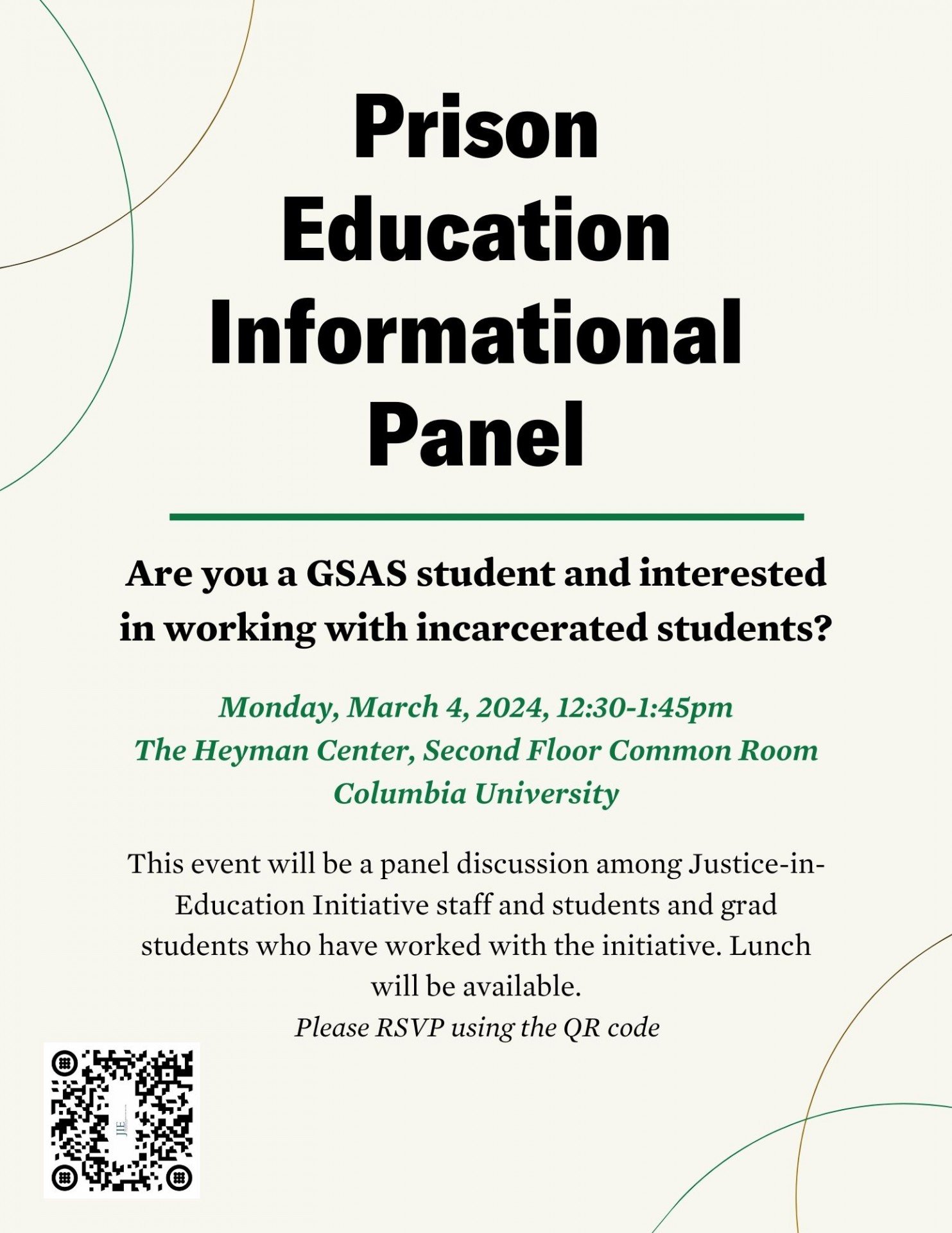
The Prison Education and Social Justice Working Group will hold an informational panel on March 4th at The Heyman Center, introducing graduate students from across Arts & Sciences to the range of paid opportunities to teach in prison contexts and support justice-impacted students through Columbia’s Justice-in-Education (JIE) Initiative.
When: Monday, March 4, 2024
12:30-1:45 PM
Where: The Heyman Center, Second Floor Common Room
Visit the event page on our website for more information and to RSVP through the CU Center for Justice
An Update on the Tremendous Work of Motherhood & Tech WG Member George Estreich
Motherhood and Technology Working group member George Estreich, who recently became the Nonfiction Editor at literary magazine AGNI, published “Tlön, Uqbar, ChatGPT” in The Journal of Philosophy and Disability, Vol. 3, 2023.
His essay "Concision: A Sprawl," originally published in AGNI, was chosen by Vivian Gornick for The Best American Essays 2023.
In February, he was part of a panel at the Associated Writing Programs conference in Kansas City: "Writing and Intellectual Disability: An Inclusive Panel." This panel included both published writers and people with Down syndrome, including his daughter Laura.
Refugee Cities WG Member Kian Tajbakhsh Publishes Piece in The Atlantic: "Iran Is Not a 'Normal' Country"
Refugee Cities Working Group member and author of Creating Local Democracy in Iran: State Building and the Politics of Decentralization (Cambridge Univ. Press, 2022), Kian Tajbakhsh recently publish an article in The Atlantic, titled “Iran Is Not a ‘Normal’ Country.” You can find the article here.
Matthew Engelke to Become Columbia's New Department of Religion Chair
After six years directing the Institute for Religion, Culture, and Public Life (IRCPL), Professor Matthew Engelke is set to assume the role of Chair for the Department of Religion at Columbia. As an Extractive Media fellow and long-time affiliate of CSSD, we congratulate Professor Engelke on this wonderful achievement.
To read more on Engelke’s plans for the department and his own work, follow this link to read the entire Columbia News interview.
Lila Abu-Lughod Interviewed by Columbia Journal: "Do Muslim Women Still Need Saving?"
CSSD Interim Director and Joseph L. Buttenwieser Professor of Social Science Lila Abu-Lughod was recently featured in an interview by Mariam Syed at the Columbia Journal to mark the twentieth anniversary of her essay and ten anniversary of her book, Do Muslim Women Need Saving? (HUP 2013).
The article, titled “Do Muslim Women Still Need Saving?: How Lila Abu-Lughod Interprets Today’s Political Reality,” explores the development of Abu-Lughod’s own ideas while also speaking to the relevance of her work in understanding current political dynamics, including the Middle East. Concerns such as the role of Muslim women in liberation efforts and the challenges of feminist activism in addressing gender violence within geopolitical contexts are brought into discussion not only with her own intellectual journey but also that of a rapidly changing world.
Click here to read the article.
RECAP: Extraction Time with Professor Brian R. Jacobson (1/25/24)
On January 25th, the Extractive Media Working Group gathered for a seminar with Caltech Professor of Visual Culture Brian R. Jacobson, who shared a draft of a chapter from his forthcoming book on the historical relationship between art and the oil industry.
Barnard Professor of Anthropology Brian Larkin offered a response to the piece, which was followed by lively discussion amongst the faculty and graduate students in attendance.


CSSD Call for Proposals 2024 (Deadline: March 8)
CSSD CALL FOR PROPOSALS 2024
Submission Deadline: Friday, March 8, 2024, by 9:00 AM

The Center for the Study of Social Difference at Columbia University (CSSD) is an interdisciplinary research center supporting collaborative projects that address gender, race, sexuality, class, and other forms of inequality to foster ethical and progressive social change. The Center’s work has two overarching research streams: “Women Creating Change” and “Imagining Justice.” Learn more about these research streams and the projects within them at socialdifference.columbia.edu.
CSSD brings together faculty in humanities, law, social sciences, medicine, and the arts, as well as artists and practitioners in the New York area and beyond, to investigate problems of social, economic, and cultural inequality. The Center’s working groups challenge the disciplinary divides among the humanities, the arts, and the social sciences by asking not only how historical categories of social difference intersect on the level of identity but also how these categories shape institutions, modes of knowing, acts of representation, and processes of globalization. The Center creates the conditions for scholars, artists, and practitioners to work collaboratively and internationally on problems of common interest and to set intellectual agendas for the future.
The Center welcomes proposals for NEW WORKING GROUPS beginning in Fall 2024.
Who is eligible:
Please note that working groups must include (but are not limited to) Columbia and Barnard faculty.
Most, but not all, CSSD working groups are led by two co-directors. At least one co-director must be Columbia or Barnard faculty and proposals must be submitted by one or more faculty members in one of Columbia's schools and/or Barnard.
We will also review working group proposals from graduate students with ABD status working in partnership with Columbia and/or Barnard faculty.
CSSD accepts proposals from all schools of Columbia and Barnard, including but not limited to Arts & Sciences, CUMC, School of the Arts, Columbia Law School, School of Journalism, and GSAPP, with preference given to groups working across schools and/or disciplines.
CSSD seeks projects that align with the mission of “Women Creating Change” or “Imagining Justice” and favors proposals from an interdisciplinary core working group (usually 5-8 people, not all of whom need to be affiliated with Columbia or Barnard). The Center encourages and facilitates international collaborations. Center support is seed money to enable working groups to get off the ground; it is the expectation of the Center that all projects will also seek
additional funding.
Amount of award:
Funding is for $35,000 over two years, with the possibility of applying for a third more public- facing year and an additional $10,000, contingent on working group interest and the availability of Center funds.
How CSSD working groups function:
Center projects typically run for two to three years. Every working group proceeds in accordance with the needs of its particular research interests, but in general, many groups tend to proceed as follows:
In year one the working group generally concentrates on focused project development, including the consolidation of a regional or international working group, exploratory seminars, and guest lectures or workshops. Year two involves the most intensive intellectual work, featuring regular working group meetings and the active participation of fellows and affiliates. Year three, if granted, is often dedicated to planning and disseminating the project’s work through a conference, the publication of conference proceedings and/or edited collections of working group scholarship, or the online publication of syllabi or other curricular materials.
Please note: CSSD does not function simply as a grant-making institution. Our active working groups create the CSSD community. Funds are administered directly by CSSD staff for the duration of the working group’s involvement with the Center, and it is expected that one (co- director) from each active working group sit on the CSSD Executive Committee. Each working group must hire a graduate student coordinator who serves as the point of connection between the CSSD staff and the working group.
Current and past working group projects include “Afro Nordic Feminisms,” “Geographies of Injustice,” “Menstrual Health and Gender Justice,” “Migrant Personhood and Rights,” “Motherhood and Technology,” “On the Frontlines: Nursing Leadership in Pandemics,” “Prison Education and Social Justice,” “Queer Theory: Here, Now, and Everywhere,” “Reframing Gendered Violence,” “Refugee Cities,” “Recovery,” “Unpayable Debt,” and “Women Mobilizing Memory.” Please review our website for detailed descriptions of all our projects and for additional information about the Center.
Use of funds:
Project directors may use CSSD project support budgets at their discretion. However, budgets typically include the following:
course relief for a project director (one course per year for two years, alternating in the case of co-project directors; specific terms to be negotiated by the individual project director with the director’s home department and/or center/institute);
stipend for one graduate student assistant required to be responsible for program support;
working group meeting lunches and/or breakfasts;
limited support for visiting scholars, public conferences, and publications.
CSSD project funds are modest, and we do not support honoraria or stipends paid to core working group members. Honoraria may be offered to event speakers or special guests from outside Columbia. CSSD encourages projects to include at least one public event per year (one model is to invite a guest collaborator with the group to give a public talk). Project directors must be willing to collaborate in the Center’s fundraising efforts and be prepared to work with the Center to seek additional funding sources.
How to apply:
Project proposal narratives should not exceed five double-spaced pages. They must include a project description and a detailed work plan for group meetings, public events, and the dissemination of project research. Proposal narratives should also describe a plan for soliciting and adjudicating applications for working group membership from the wider University community and any anticipated curricular or pedagogical outcomes of the proposed project.
Please also include, in addition to the above:
a short CV or bio for each tentative working group member – e.g., one paragraph summary bios (indicate if participation has been confirmed)
proposed budget (please use the provided budget template)
Staff are available to discuss potential projects with colleagues who are thinking about proposing them, and sample CSSD project proposals are available by request. Please write to the Faculty Director, Lila Abu-Lughod, at la310@columbia.edu and/or the Associate Director, Kasheba Marshall, at km2803@columbia.edu with any questions as you develop your proposal. We encourage you to contact us before submitting your proposal. Complete proposals should be emailed to CSSD at km2803@columbia.edu by Friday, March 8, at 9:00 AM, with the subject line CSSD Proposal. The CSSD Executive Committee will select the winning projects. All applicants will be notified by April 01, 2024.
CONTACT
Center for the Study of Social Difference Columbia University
1200 Amsterdam Avenue
767 Schermerhorn Extension, MC 5510 New York, NY 10027
(212) 854-7090
socialdifference@columbia.edu
JOIN THE CSSD MAILING LIST
The Institute of Fine Art to Host Discussion on Anooradha Iyer Siddiqi's Architecture of Migration
Slated to continue an exciting book tour following her upcoming February 6 event at the Heyman Center, Insurgent Domesticities co-director Anooradha Iyer Siddiqi will be hosted the following week for a discussion of her latest work, Architecture of Migration: The Dadaab Refugee Camp and Humanitarian Settlement (Duke University Press, 2023), at yet another renowned institution.
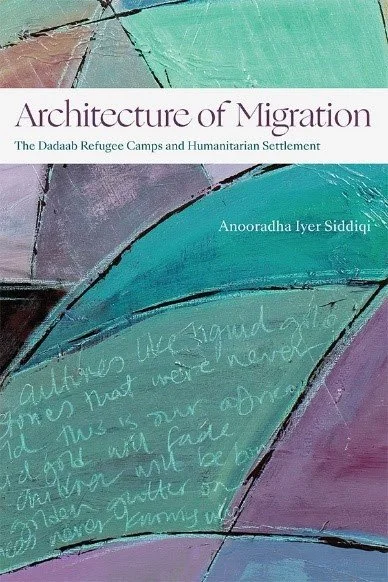
The discussion will be conducted with Professor Prita Meier, associate professor of African art and architectural history at the Institute of Fine Arts and Department of Art History.
When: 6 PM on Tuesday, February 13
Where: James B. Duke House
Forthcoming Memoir by Motherhood & Technology Working Group Fellow Emily Bloom
Warm congratulations to Emily Bloom, a Motherhood and Technology Working Group member and Mellon Public Humanities Fellow at Sarah Lawrence University, for her forthcoming book, I Cannot Control Everything Forever: A Memoir of Motherhood, Science, and Art (St. Martin’s Press, 2024).
Fellow Working Group member Rachel Adams has praised the memoir, saying: “A big-hearted, wise, and beautifully written account of longing for and diving into motherhood, of parenting a child with unexpected challenges, and the technologies that sustain and complicate our lives. I wanted to read on to know what happened next and I did not want it to end.”
The Extractive Media WG Releases its Spring 2024 Events Lists

The Extractive Media Working Group has released its Spring 2024 Events Flyer listing its upcoming programming for the semester.
Follow this link to see upcoming events at CSSD.